Journal · 2026-10-05
Who Should Get Combo Brows? The Best of Both Techniques
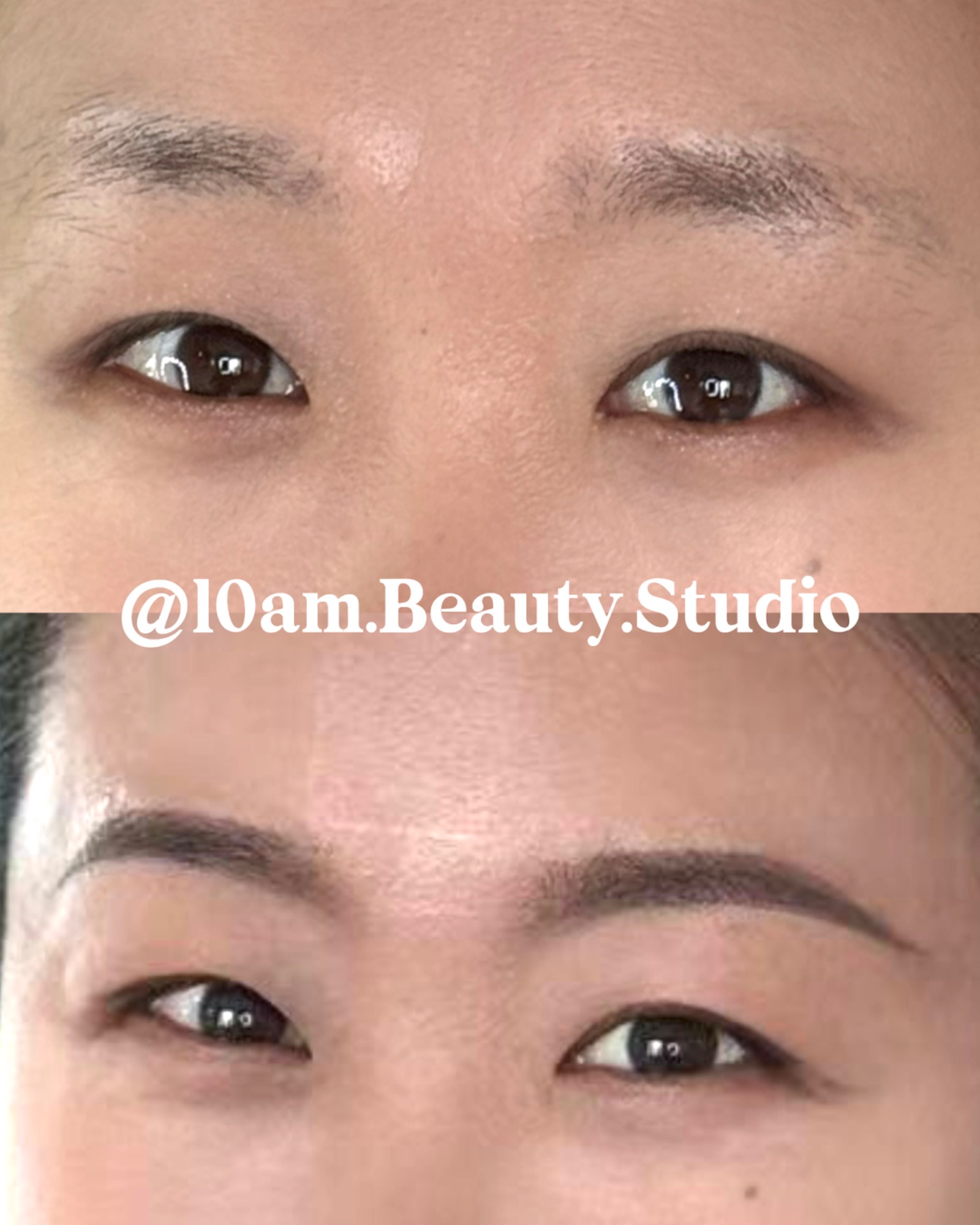 [POWDER BROWS, BEFORE / HEALED]
If you've been scrolling brow techniques, you've probably hit the same fork in the road every client hits: crisp hair strokes, or soft powder shading? Combo brows are what I suggest when someone wants both — delicate nano hairstrokes at the front of the brow that fade seamlessly into soft powder shading through the arch and tail. It's not two procedures stacked together. It's one brow design, planned as a whole, so you never see where the strokes end and the shading begins.
The logic follows how real brows grow. The front of your brow — the bulb, closest to your nose — is where natural hair grows sparsest and softest. That's where I place the hairstrokes: fine, airy, mimicking real growth. From the arch back through the tail, real brows grow denser, so I switch to shading for that filled-in, defined finish. Done right, combo brows don't read as "tattooed." They read as a really good natural brow.
You're a great candidate if...
You fill in your brows with makeup most days. Honestly, this is the clearest sign. If your morning routine includes a pencil, powder, or gel to get the shape you like, combo brows give you that look without the daily work. You wake up with the shape already there — and on no-makeup days you still look finished, not bare.
Your brow fronts are sparse but you want a defined tail. A lot of my clients have thin, patchy growth near the inner brow and then want that clean, lifted shape through the arch. Strokes alone can look too wispy on them; powder alone can look too heavy at the front. Combo splits the difference exactly where each technique shines.
You have normal, combination, or mildly oily skin. Here's the technical part: on very oily skin, individual hairstrokes can soften and blur faster than we'd like. But shading holds beautifully on oily skin. With combo brows, the shading through the arch and tail carries the design long-term, while the strokes at the front give softness in the first year or so. It's a more forgiving combination than full strokes on oilier skin.
You have old powder brows and want to soften them. If your previous powder work has faded to a soft wash of color, adding fresh hairstrokes at the front is one of my favorite corrections — it breaks up that flat, stamped look and brings back a natural hairline edge. This only works if the old pigment is faded enough, which is something I check in person.
You tried nano or microblading and want more fullness. Strokes give texture, but they don't give density. If your healed strokes look a little sheer — especially toward the tail — layering in soft shading behind them fills the gaps without losing the natural feel.
Who should probably skip combo brows
You want a pure hair-stroke look, nothing else. Some clients are very specific: they want every millimeter to look like individual hairs, no shading at all. That's a valid preference — and it's exactly what nano hairstroke brows are for. Forcing shading into a design where the client doesn't want it never ends well.
You want a bold, defined, makeup-heavy brow. If your everyday look is a sharp, sculpted brow — think full glam, clean edges — full powder/ombré brows will serve you better. Combo brows are designed to look natural; they won't give you that crisp Instagram-brow edge.
Your skin is extremely oily. Let me be direct: on very oily skin, hairstrokes can blur and spread sooner than expected. When oil is the dominant factor, I usually recommend full powder shading — it heals the most predictably and holds its shape longest. I'd rather tell you that in a consultation than have you pay for strokes that won't stay crisp.
How combo brows heal and how long they last
Healing follows the same timeline as other brow techniques: the first week the color looks darker and more defined than the final result, then light flaking happens around days 5–10, and the true healed color settles in around week 4–6. One thing combo clients notice: the hairstrokes soften a little faster than the shading. That's normal — shading is simply denser pigment, so it holds longer.
For longevity, expect combo brows to fade gradually over 1 to 3 years — the same as our other brow techniques. Most clients come back for a color refresh around 12–18 months, when the strokes have softened and they want that crispness back. Nothing we do is 100% permanent or lasts forever, and I'd be suspicious of any artist who promises that. The fading is actually the feature: it means your brows can evolve as your face, hair color, and preferences change.
The ratio is customized at your mapping appointment
There's no fixed recipe for combo brows — no "40% strokes, 60% shading" rule. At your consultation and brow mapping session, I look at your natural hair growth, your bone structure, your skin, and how you do your makeup, and then we design the balance together. Sparse fronts and a love of defined tails? More strokes up front, stronger shading behind. Thicker natural hair and a softer preference? Barely-there shading that just fills the gaps. The mapping is drawn on your face first, so you see the shape and approve it before anything permanent happens. The session is $15, and if you decide to move forward with permanent makeup, you get a $45 credit toward your final fee (promo through Dec 31).
Still torn between techniques? Our 60-second brow quiz asks four quick questions and points you toward nano, powder, combo, or a consultation first. And if you'd rather talk it through with a human, read more about combo brows here or book that mapping session — deciding together in person is always the most accurate way.
Quick answers
Do combo brows look natural?
Yes — that's the entire point of the technique. The hairstrokes at the front mimic real growth, and the shading is diffused rather than stamped on. Most people won't know you've had anything done; they'll just think you have great brows.
How long do combo brows last compared to powder alone?
About the same overall — both fade gradually over 1 to 3 years; exact fading depends on the pigment, your skin, and aftercare. The difference is that the hairstrokes soften first, usually around 12–18 months, while the shading holds longer. A color refresh at 12–18 months keeps everything crisp.
Can combo brows cover old microblading or powder?
Sometimes. If the old work has faded to a soft, light wash, fresh shading can even it out and new strokes can soften the front. If the old pigment is still dark or dense, removal or more fading time may be needed first. Bring bare, makeup-free photos to a consultation for an honest assessment.
Are combo brows good for oily skin?
They're a solid choice for normal to mildly oily skin, since the shading carries the design even as the strokes soften. But on very oily skin, hairstrokes can blur sooner than expected — in that case full powder shading usually heals more predictably. Skin assessment happens at the mapping appointment.
Ready for easier mornings?
Start with a custom brow design and see your shape before you commit.